Launch offer — valid today only

📄 Digital book in PDF · read it on your phone or print it

COA Exam Prep: The Eye Workup in the Same Order Every Time Every Step of the Eye Workup, Illustrated

Eye anatomy, diopters, transposition, acuity and pinhole, pupils and RAPD, the cover test, tonometry, the lensometer and eye drops: in your study guide it's a wall of text. Here each topic fits on one page, with the drawing and what you need to remember. 64 illustrated pages.

YES, I WANT THE ILLUSTRATED GUIDE

🔒 Secure checkout · PDF by email · 30-day guarantee

One topic per pagethe drawing shows you the technique and the text walks you through it
64 illustrated pages9 parts, from eye anatomy to the night before your COA exam
Up-to-date sourcesIJCAHPO's COA content outline, AAO references and CDC guidance
PDF by emailFormat

This Is What the Pages You Will Study Look Like

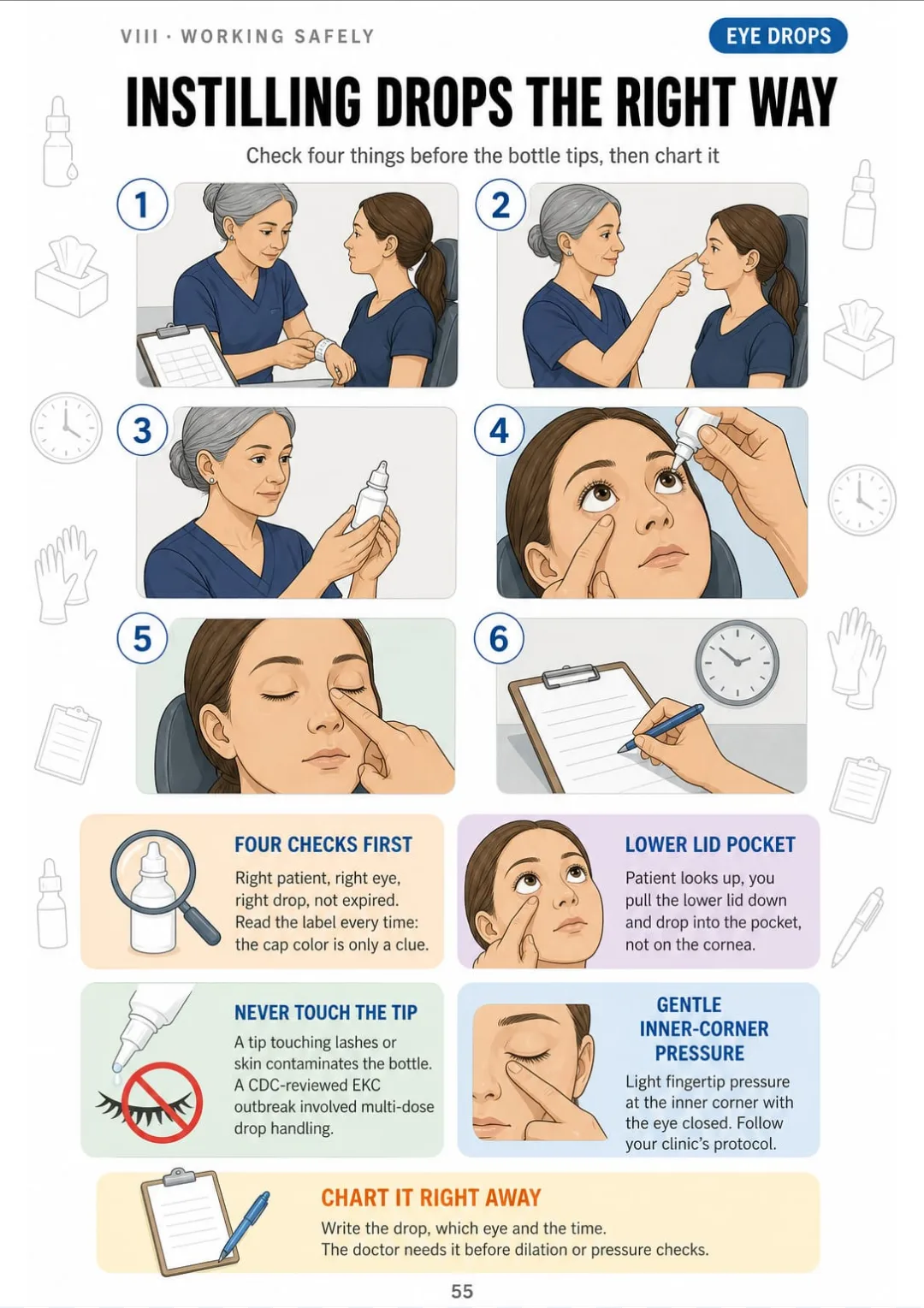
One topic per page, the drawing that shows you how it's done and the boxes with what you need to know:

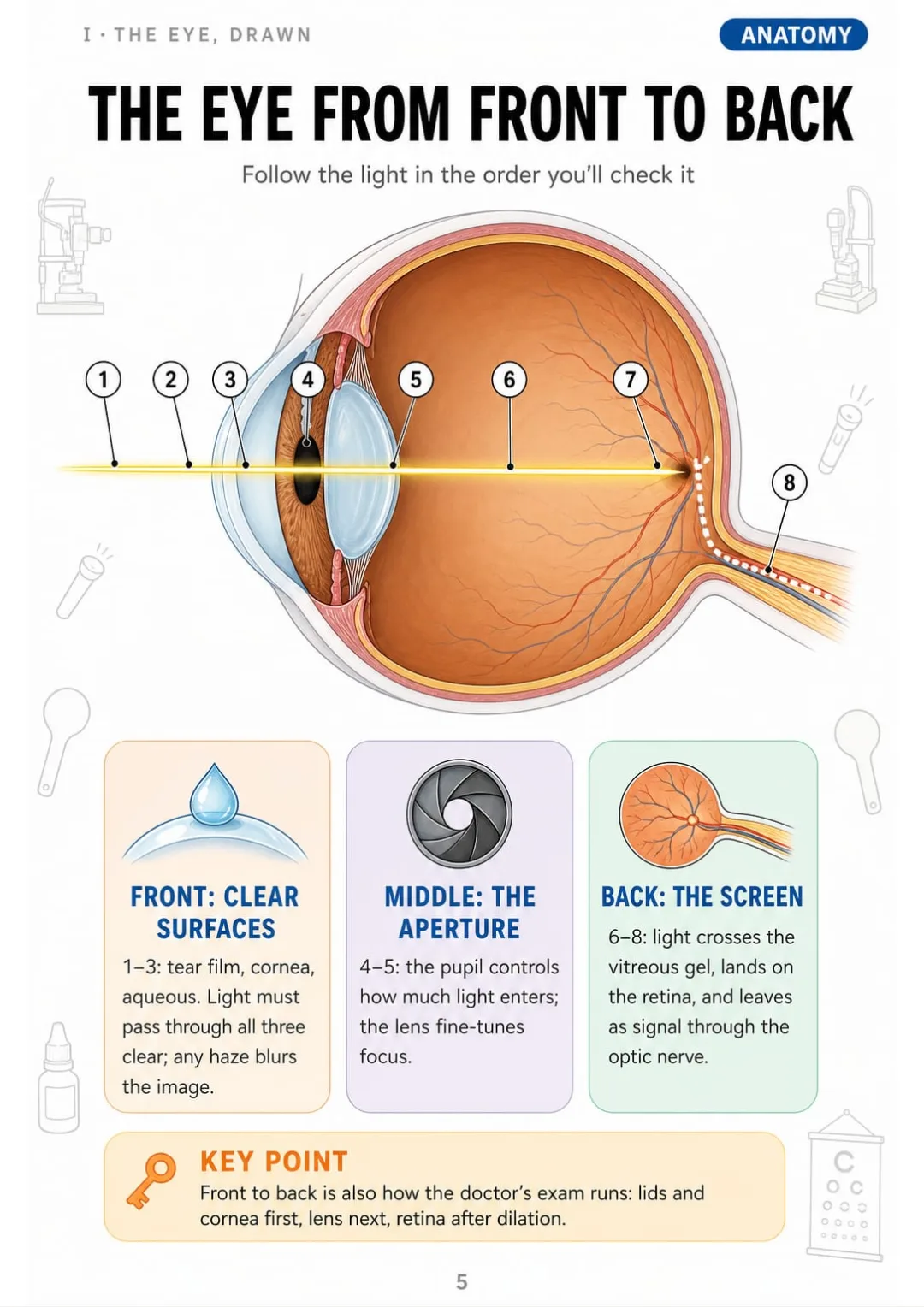
Tear film → cornea → aqueous → pupil → lens → vitreous → retina → optic nerve, numbered 1 to 8.
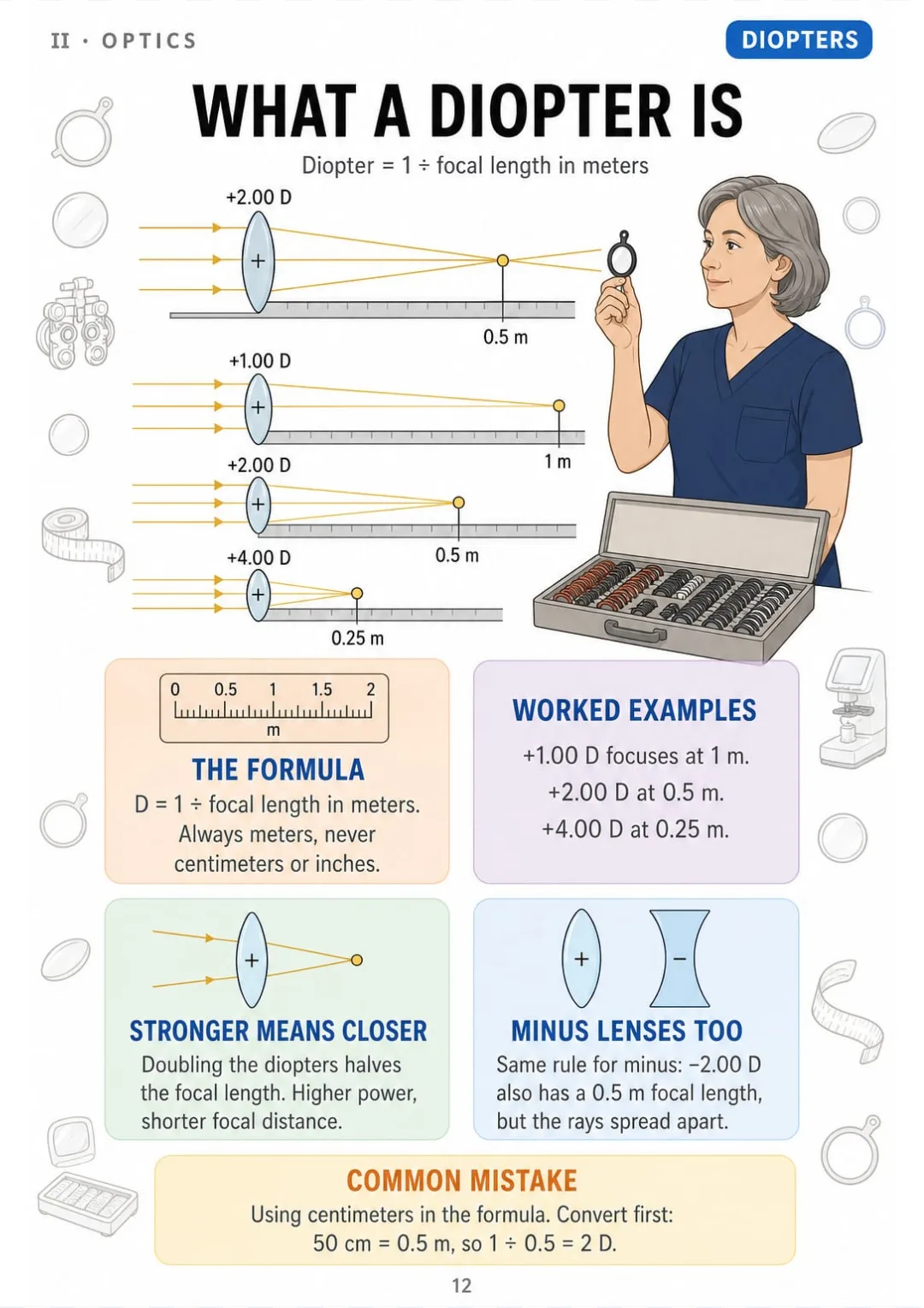
+2.00 D focuses at 0.5 m: D = 1 ÷ focal length in meters.
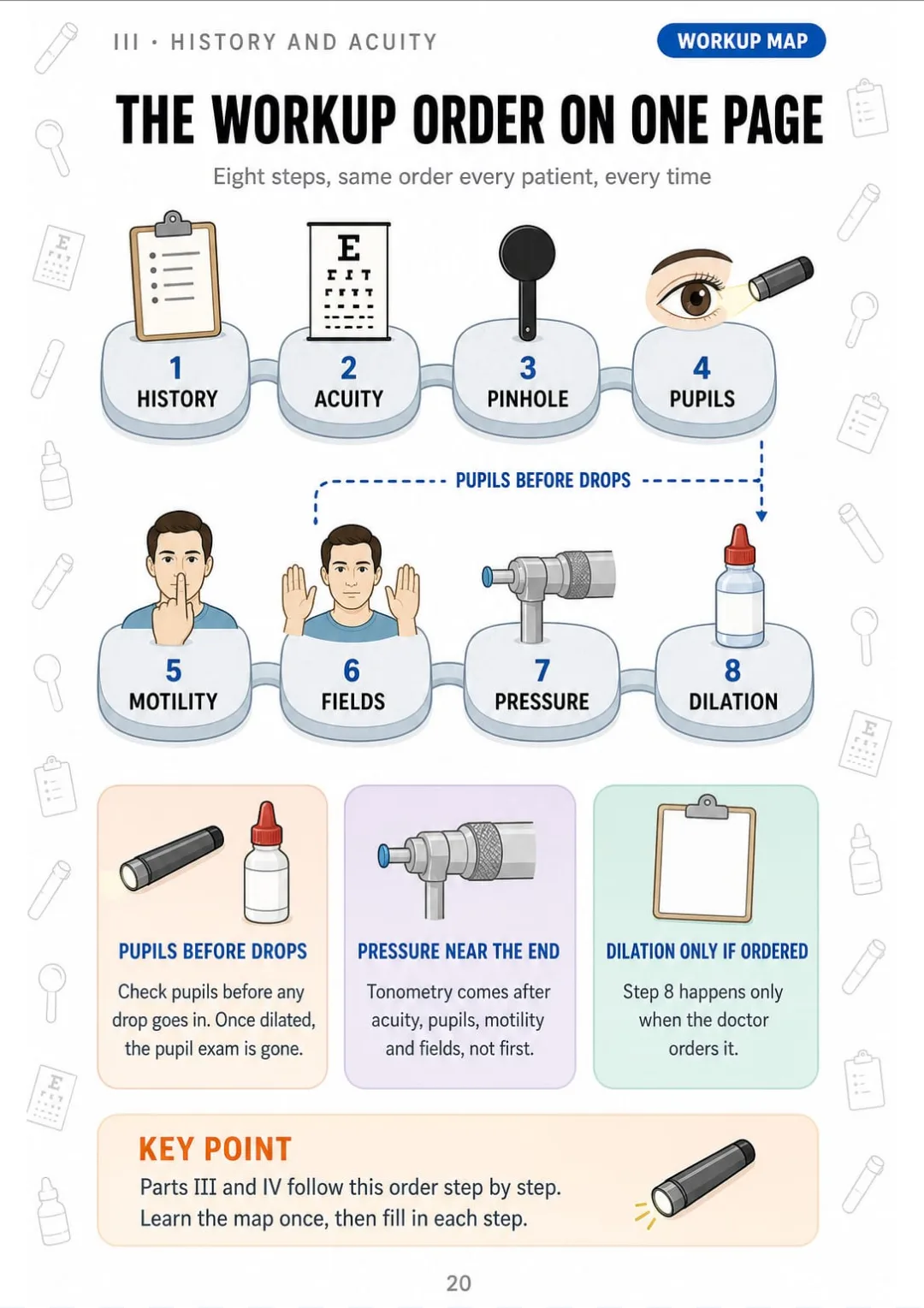
History → acuity → pinhole → pupils → motility → fields → pressure → dilation if ordered.
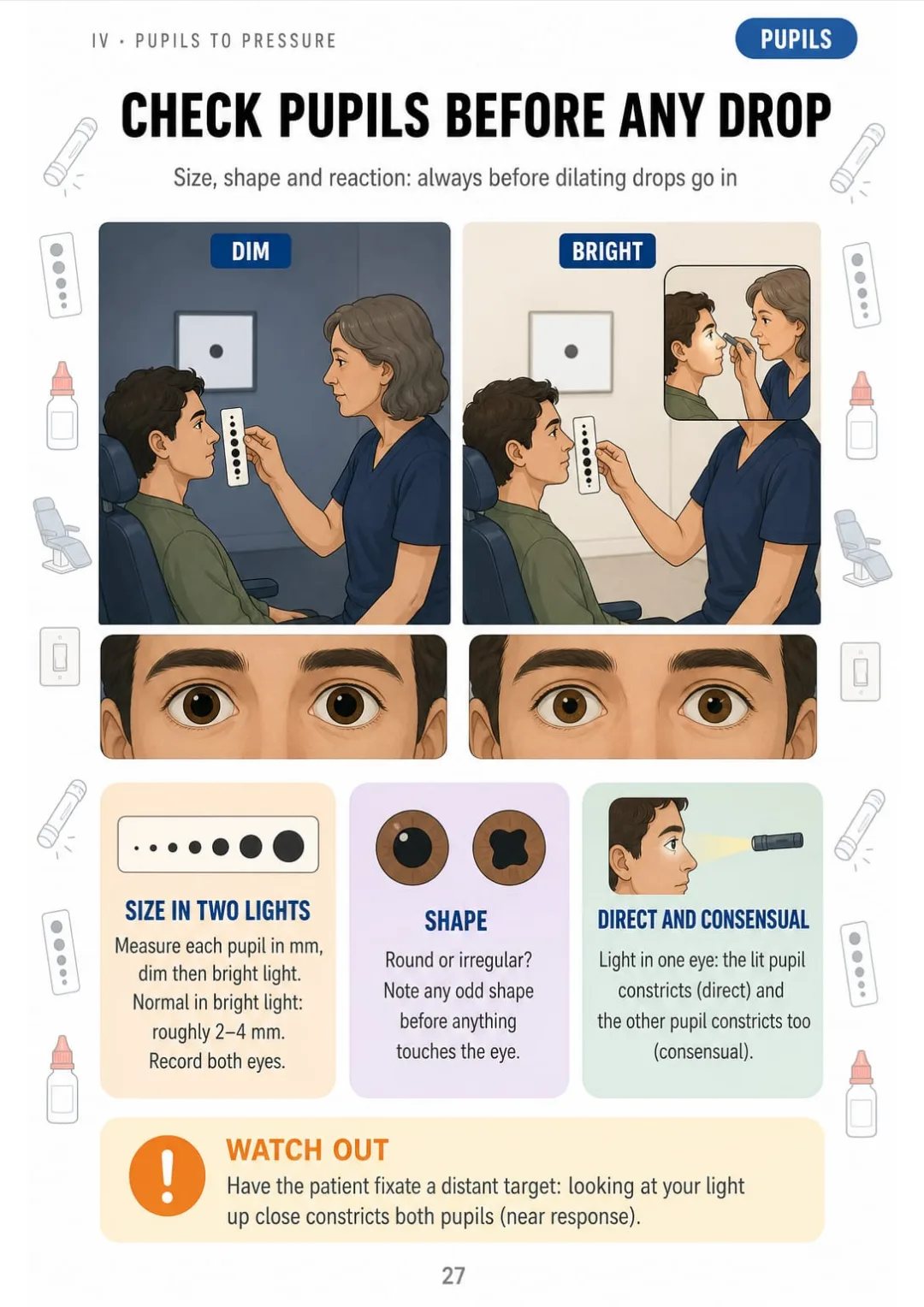
Pupils: size in dim and bright light, shape, direct and consensual reaction, always before drops.
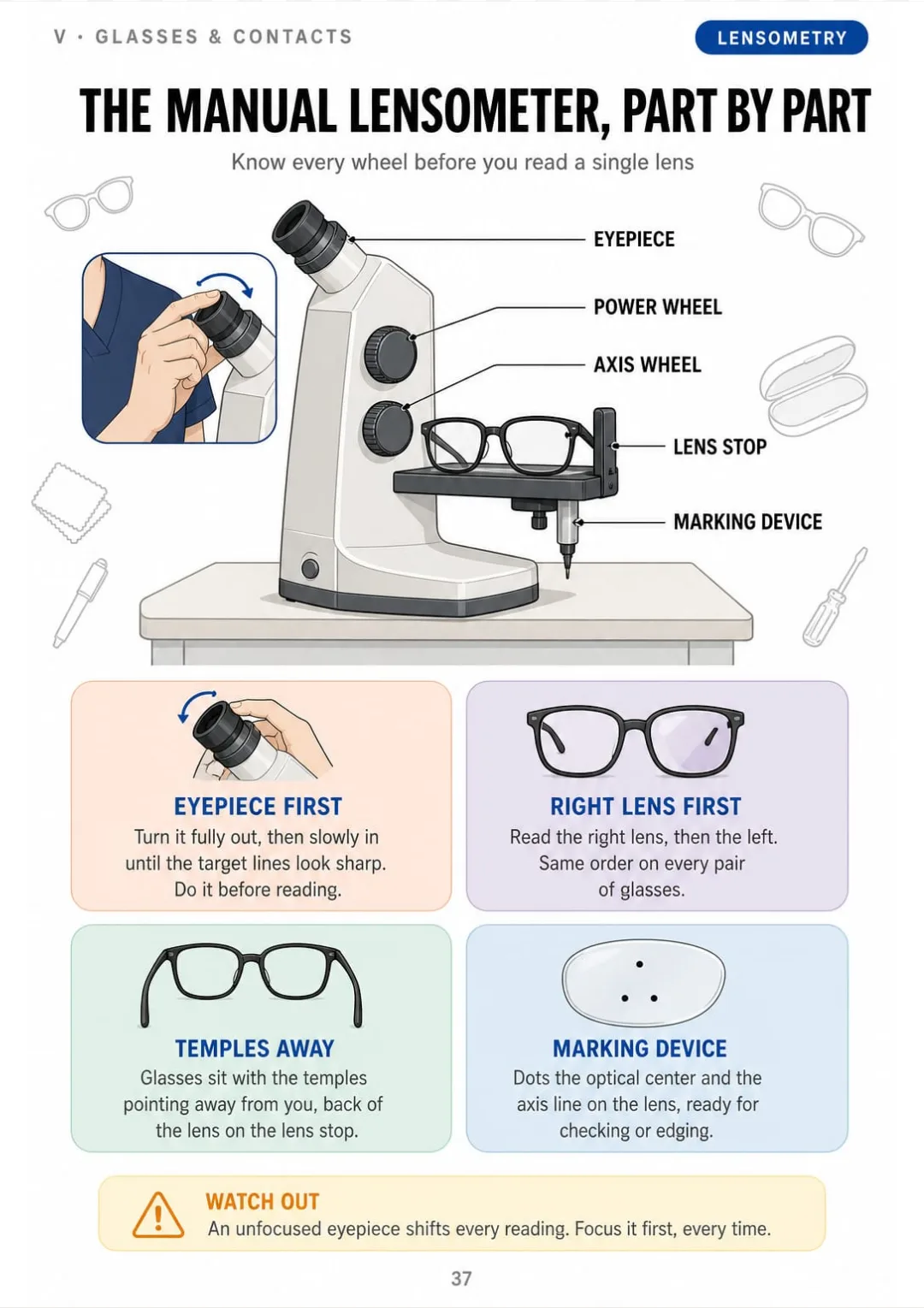
Eyepiece, power wheel, axis wheel, lens stop, marking device: focus first, right lens first.
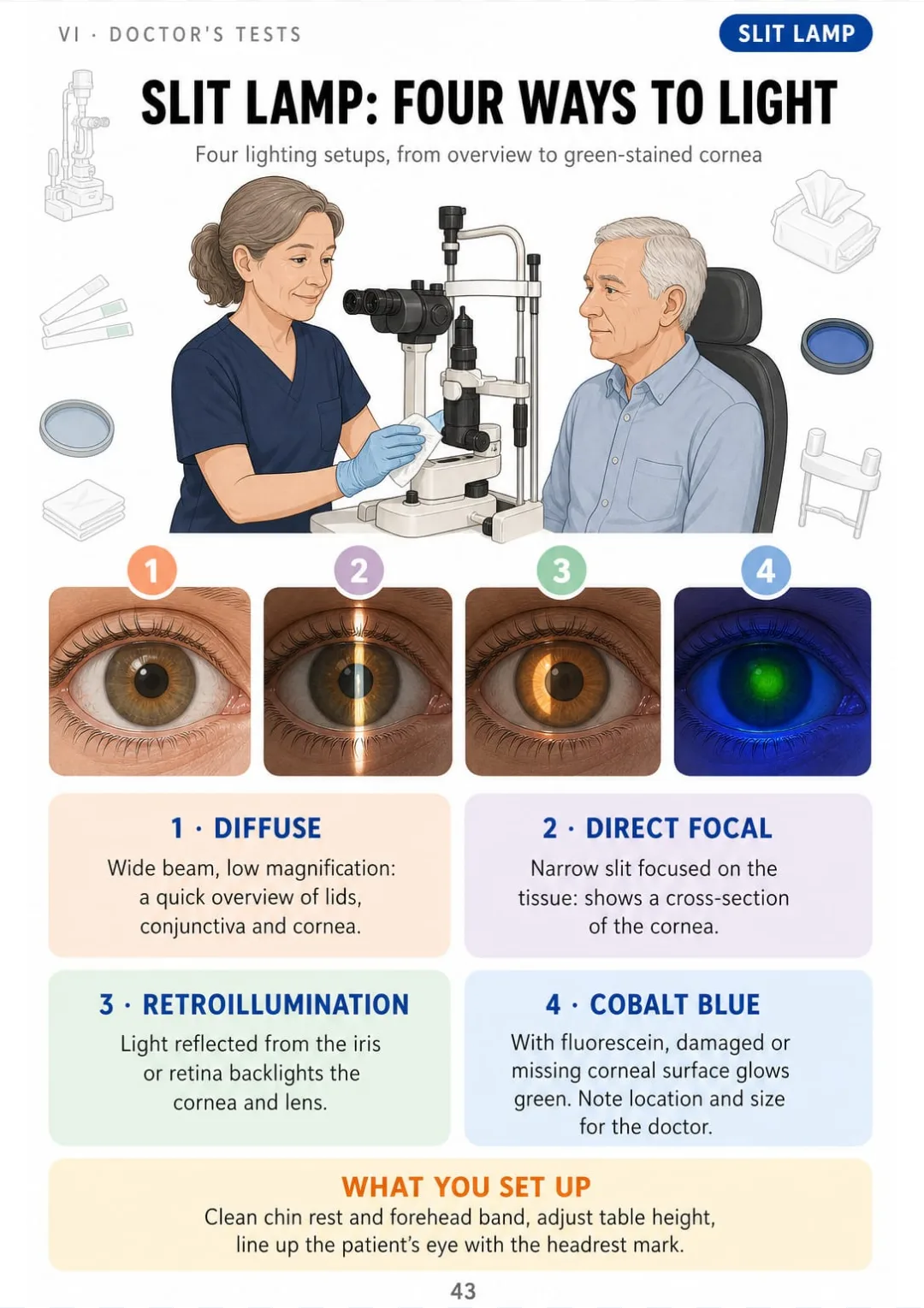
Diffuse, direct focal, retroillumination and cobalt blue: one picture each.
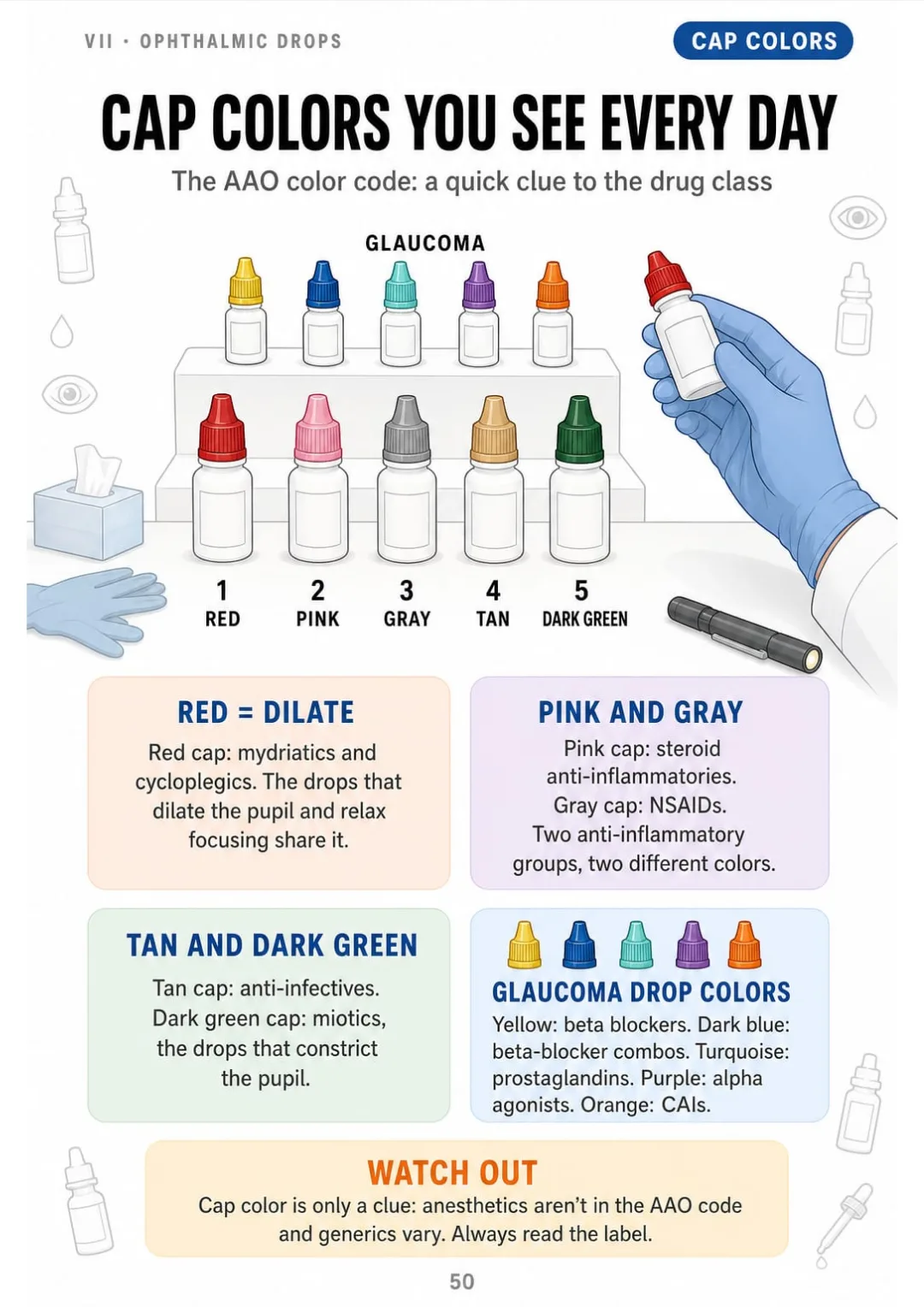
AAO cap code: red dilates, pink steroid, gray NSAID, tan anti-infective, dark green miotic, plus glaucoma colors.
Right patient, right eye, right drop, not expired: then the lid pocket and the time on the chart.

Swipe to see more →

These are real pages from the book. The table of contents is the full one: 9 parts and 60 topics.

It's Not That You Have a Bad Memory. It's That Nobody Put It in Order.

You've read the workup chapter three times. You close the study guide...

...and you're not sure anymore if pupils come before or after the pinhole, or where pressure goes. It was just line after line.

History → acuity → pinhole → pupils → motility → fields → pressure → dilation if ordered.

Here the workup is one page, drawn as a sequence: history, acuity, pinhole, pupils, motility, fields, pressure, and dilation only if the doctor orders it.

And on the pages next to it, every test has its own: the swinging flashlight test, the cover test, confrontation fields, Goldmann applanation and the lensometer.

First you understand why it's done that way. Then the order sticks on its own.

SEE THE DIFFERENCE

Stop Memorizing Optics Formulas You Can't Picture:

THIS
  • Pages and pages of dense text
  • Optics formulas without a single drawing
  • On the exam, you don't know where to start
The diopter (D) is the unit of measurement of the refractive power of a lens and is defined as the reciprocal of the focal length expressed in meters (D = 1/f). Converging lenses are designated by a positive sign and diverging lenses by a negative sign. Accordingly, a lens of +2.00 D brings parallel rays of light to a focus at 0.50 m, whereas a lens of +4.00 D focuses at 0.25 m, the relationship between power and focal length being inversely proportional, such that any increase in dioptric power results in a correspondingly shorter focal distance.
FOR THIS
  • Every formula drawn
  • One topic per page, with the rules in boxes
  • You remember it because you've seen it
+2.00 D focuses at 0.5 m: D = 1 ÷ focal length in meters.
CONTENTS

Take a Look at the 9 Parts and 60 Topics

Eye anatomy, optics, history and acuity, pupils, motility, fields and pressure, glasses and lensometry, the tests the doctor orders, eye drops, working safely and the final review: 64 pages, all illustrated

IThe Eye, Drawn · pp. 5-11
  1. The eye from front to back
  2. Cornea, sclera and conjunctiva
  3. Iris, pupil and the two muscles
  4. Lens and accommodation
  5. Aqueous flow and the drainage angle
  6. Retina, macula and optic nerve
  7. Eyelids, tears and the orbit
IIOptics Without the Headache · pp. 12-19
  1. What a diopter is
  2. Plus lenses, minus lenses
  3. Myopia, hyperopia and astigmatism
  4. Presbyopia and the add
  5. Reading a written prescription
  6. Transposition in three steps
  7. Spherical equivalent
  8. Prism and Prentice's rule
IIIWorkup Step 1: History and Acuity · pp. 20-26
  1. The workup order on one page
  2. Taking the ophthalmic history
  3. Distance acuity with the Snellen chart
  4. When they can't read the big E
  5. The pinhole test
  6. Near acuity
  7. Kids and patients who can't read letters
IVWorkup Step 2: Pupils, Motility, Fields and Pressure · pp. 27-36
  1. Checking pupils before any drop
  2. The swinging flashlight test and RAPD
  3. Anisocoria: which pupil is the abnormal one
  4. Six muscles, six cardinal gazes
  5. Cover-uncover vs. alternate cover
  6. Near point of convergence and stereo
  7. Confrontation visual fields
  8. Amsler grid
  9. Tonometry: what the number means
  10. Goldmann applanation, step by step
VGlasses, Lensometry and Contacts · pp. 37-42
  1. The manual lensometer, part by part
  2. Reading a single-vision lens
  3. Bifocals, progressives and the add
  4. Pupillary distance
  5. Contact lenses: soft vs. rigid
  6. Teaching insertion, removal and care
VIThe Tests the Doctor Orders · pp. 43-49
  1. Slit lamp basics
  2. Keratometry
  3. A-scan biometry for cataract surgery
  4. Automated visual fields
  5. OCT: what it scans
  6. Color vision and stereo testing
  7. Tear tests and exophthalmometry
VIIOphthalmic Drops (Study Only) · pp. 50-54
  1. Cap colors you see every day
  2. Dilating drops vs. cycloplegic drops
  3. Checking the angle before dilating
  4. Anesthetic and diagnostic drops
  5. Glaucoma drop classes
VIIIWorking Safely in the Clinic · pp. 55-59
  1. Instilling drops the right way
  2. Cleaning the tonometer and the room
  3. Triage: what can't wait
  4. Charting and abbreviations
  5. HIPAA and the patient in the chair
IXReview and Checklists · pp. 60-64
  1. The full workup checklist
  2. Optics formulas on one page
  3. Normal values to keep handy
  4. Frequent mistakes in the workup
  5. Before your COA exam

What If Every Topic Fit on a Single Page?

Picture this:

Instead of rereading half a page on transposition without being able to see it...

...you open the page and find the same lens drawn twice, once in plus cylinder and once in minus cylinder, with the three steps written right next to it.

Eyepiece, power wheel, axis wheel, lens stop, marking device: focus first, right lens first.

And the diopter, the swinging flashlight test, the six cardinal gazes, the lensometer and the cap colors turn into drawings and tables you read at a glance.

You stop repeating and start understanding.

That's what Ophthalmic Assistant Illustrated does: 64 illustrated pages in 9 parts, one topic per page. And at the end, the full workup checklist, the optics formulas and the normal values, each on one page.

Because what your brain sees organized, it remembers.

Here Is What You Get with Ophthalmic Assistant Illustrated:

Ipp. 5-11

The Eye, Drawn

The eye from front to back, cornea and sclera, iris and pupil, the lens and accommodation, aqueous flow and the angle, retina and optic nerve, lids, tears and orbit.

IIpp. 12-19

Optics Without the Headache

What a diopter is, plus and minus lenses, myopia, hyperopia and astigmatism, presbyopia and the add, reading a prescription, transposition, spherical equivalent and Prentice's rule: the optics you can finally picture, so you transpose a prescription without stopping to think.

IIIpp. 20-26

Workup Step 1: History and Acuity

The workup order on one page, the ophthalmic history, Snellen acuity, when they can't read the big E, the pinhole, near acuity and kids.

IVpp. 27-36

Workup Step 2: Pupils, Motility, Fields and Pressure

Pupils before any drop, the swinging flashlight test and RAPD, anisocoria, the six cardinal gazes, cover tests, convergence and stereo, confrontation fields, Amsler grid and tonometry.

Vpp. 37-42

Glasses, Lensometry and Contacts

The manual lensometer part by part, single-vision lenses, bifocals and progressives, pupillary distance, soft vs. rigid contacts and teaching care: so when the doctor hands you a pair of glasses, you know where to start.

VIpp. 43-49

The Tests the Doctor Orders

Slit lamp basics, keratometry, A-scan biometry, automated fields, OCT, color vision and stereo, tear tests and exophthalmometry.

VIIpp. 50-54

Ophthalmic Drops (Study Only)

Cap colors, dilating vs. cycloplegic drops, checking the angle before dilating, anesthetic and diagnostic drops, and glaucoma drop classes, for study only.

VIIIpp. 55-59

Working Safely in the Clinic

Instilling drops the right way, cleaning the tonometer and the room, what can't wait in triage, charting and abbreviations, and HIPAA.

IXpp. 60-64

Review and Checklists

The full workup checklist, optics formulas on one page, normal values to keep handy, frequent mistakes and what to review before your COA exam.

At the end of the book: The full workup checklist, the optics formulas and the normal values, each on one page.


And That Is Not All: 2 More Books, Free

Eye Workup Drills: Lensometry, Transposition & Acuity Cases

BONUS 1: «Eye Workup Drills: Lensometry, Transposition & Acuity Cases»

Value on its own: US$ 17.90

Practice the parts that trip people up most, with worked cases you solve step by step and check right away: transposing prescriptions, spherical equivalent, reading the lensometer and recording acuity.

Common Mistakes in the Eye Workup

BONUS 2: «Common Mistakes in the Eye Workup»

Value on its own: US$ 14.90

Review the most frequent slips in one place, each with the right way to do it: OD and OS swapped, sign errors in transposition, a rushed swinging-flashlight test, pinhole skipped.

Ophthalmic Assistant Illustrated + 2 Free Books

  • Ophthalmic Assistant Illustrated: 64 illustrated pagesUS$ 63
  • BONUS 1: Eye Workup Drills: Lensometry, Transposition & Acuity CasesUS$ 17.90
  • BONUS 2: Common Mistakes in the Eye WorkupUS$ 14.90
  • High-resolution PDF to printIncluded
Total value US$ 95.80
YOUR PRICE:
US$ 27
You save US$ 68.80
YES, I WANT OPHTHALMIC ASSISTANT ILLUSTRATED FOR US$ 27

📄 This is a digital PDF book sent to your email: nothing is printed or shipped.

Secure purchaseEncrypted payment30-day guarantee

PDF by email: Ophthalmic Assistant Illustrated reaches your inbox as a PDF, and the two free books come by email too. One-time payment, no installments or hidden costs.

Is This Book for You?

You're new to the eye clinic

You're new to the eye clinic

Anatomy, optics and the workup in the order you'll do it in the exam room, one topic per page, to review before your shift.

Your COA exam is coming up

Your COA exam is coming up

Organized around the COA content outline in 64 illustrated pages, with the optics worked out step by step and the full workup checklist at the end.

You've done the workup for years

You've done the workup for years

The theory behind what your hands already know: why the pinhole helps, how RAPD works, how to transpose without stopping to think.

To Sum Up: Here Is What You Get

US$ 95.80US$ 27
YES, I WANT OPHTHALMIC ASSISTANT ILLUSTRATED FOR US$ 27

📄 This is a digital PDF book sent to your email: nothing is printed or shipped.

30DAYS
GUARANTEE

30-Day Guarantee

You have 30 days to try Ophthalmic Assistant Illustrated and the two bonus books.

If a file doesn't open, if the content isn't what this page describes, if you were charged twice or the email never arrived, write to us and we'll refund you in full.

One-time payment, no subscriptions, no surprises.

Frequently Asked Questions

How do I get the material?

You get an email with Ophthalmic Assistant Illustrated as a high-resolution PDF, to read on your phone or print. The two bonus books, Eye Workup Drills and Common Mistakes in the Eye Workup, come by email too.

Is it a monthly payment or a one-time payment?

One-time payment. No installments and no subscription.

Who is it for?

For ophthalmic assistants, technicians and scribes, for anyone preparing for the COA exam, and for medical assistants moving into eye care. It starts from the eye's anatomy, so you don't need a background in optics; if you've done the workup for years, it's a fast review in order. Check the table of contents above to see every topic.

What sources is it based on?

On the current COA exam content outline published by IJCAHPO, cross-checked against current American Academy of Ophthalmology references and CDC infection-control guidance for ophthalmic devices. The book is organized around the same areas the outline covers.

Is this official COA material?

No. It's an independent illustrated study book, not affiliated with or endorsed by IJCAHPO. It doesn't give a certificate or CE credits, and it doesn't count toward the COA eligibility requirements: it's a book to study and review with.

Does it replace my training or a COA prep course?

No. It's a visual review that goes alongside your training, your clinic's protocols and the doctor's instructions. It's study material, not medical advice.

Are the practice cases the real exam questions?

No. The drills and cases are written for this book. They aren't official exam questions: they're there to help you practice.

Can I print it?

Yes. It's a high-resolution PDF: print the whole book or just the pages you want to keep at your station.

What does the 30-day guarantee cover?

You have 30 days. If a file doesn't open, if the content isn't what this page describes, if you were charged twice or the email never arrived, write to us and we'll refund you in full.

What if I don't like it?

You have 30 days: if a file doesn't open, if the content isn't what this page describes, if you were charged twice or the email never arrived, write to us and we'll refund you in full.

One Last Thing Before You Decide...

You don't have to reread the same page hoping it sticks this time.

You don't have to memorize optics formulas you can't picture.

And you definitely don't have to walk into the exam not knowing where to start.

There's an easier way. And it's one click away.

Your move.

One-time payment: US$ 27 · Guarantee: 30 days · PDF by email

YES, I WANT OPHTHALMIC ASSISTANT ILLUSTRATED FOR US$ 27

📄 This is a digital PDF book sent to your email: nothing is printed or shipped.